Mexico City and Mérida: A Tale of Two Unsung Cities
Most international trips to Mexico land at a coast and stay there.
The country's reputation rests overwhelmingly on its beaches — the Riviera Maya, the Pacific resorts, the bay sequence of Tulum, Cancún, and Playa del Carmen. None of these are wrong reasons to visit. But they account for a fraction of what the country is, and for travellers willing to look slightly inland, the most rewarding Mexico tends to live in its cities.
Two in particular deserve the time. Mexico City — vast, layered, frequently overwhelming, easily one of the great capitals of the Americas. And Mérida — quieter, smaller, defined by colonial architecture and a tempo entirely unlike the capital's. They are different in almost every measurable way, and that difference is the reason to pair them.
Neither is on most international Mexico itineraries. Both probably should be.
Mexico City: five nights for a first visit
Five nights is the right length. Less and the city compresses into a blur of half-finished impressions; more, on a first trip, and the saturation begins to dull what is initially overwhelming.
Mexico City is enormous, dense, and visibly layered — pre-Hispanic stonework underneath colonial churches underneath modernist apartment blocks underneath contemporary glass. Whole districts shift in character over a few blocks. Polanco is the polished international zone, dense with diplomatic missions and hotels. Roma and Condesa are leafy, walkable, design-led. Centro Histórico holds the institutional and historical weight. Coyoacán, further out, retains an older character closer to a town.
For travellers prioritising comfort and dining access, Polanco is the most logical base. Roma or Condesa work well for those who want cultural immersion and walkability over ease.
A specific note on food. Mexico City is not, principally, a fine-dining destination, although it does have remarkable formal restaurants that command global attention. The defining culinary pleasure lives at street level — tacos al pastor from the trompo at a corner stall on a Saturday night, tlacoyos at neighbourhood markets, mezcalerías where the bottle and the conversation outlast the meal. A separate Journal piece on Mexican cuisine goes deeper.
Beyond the city: Teotihuacán, Xochimilco, Coyoacán
The single most rewarding day trip from Mexico City is Teotihuacán, an hour north of the centre by road.
The site is enormous — the third-largest pyramid complex in the world, built between roughly 100 BCE and 250 CE, and named the place where the gods were made by the Aztecs who arrived centuries after its collapse. Walking the Avenue of the Dead between the Pyramids of the Sun and Moon is a different scale of historical encounter from anything in the city itself. Going early — gates open at nine — beats both the heat and the crowds.
Two other outings deserve mention. Xochimilco, the canal network at the southern edge of the city, is a Sunday institution: small painted boats, families on the water, food vendors paddling between them, a survival of the floodplain agriculture that pre-dates the Spanish. Coyoacán, slightly nearer the centre, offers Frida Kahlo's Casa Azul, colonial squares, and a quieter afternoon than the central districts.
These outings make the strong case for five nights rather than three. The city alone holds three days easily; the day trips add the dimension that completes it.
The flight south
A short flight to Mérida — under two hours from Mexico City — opens the second half of the trip.
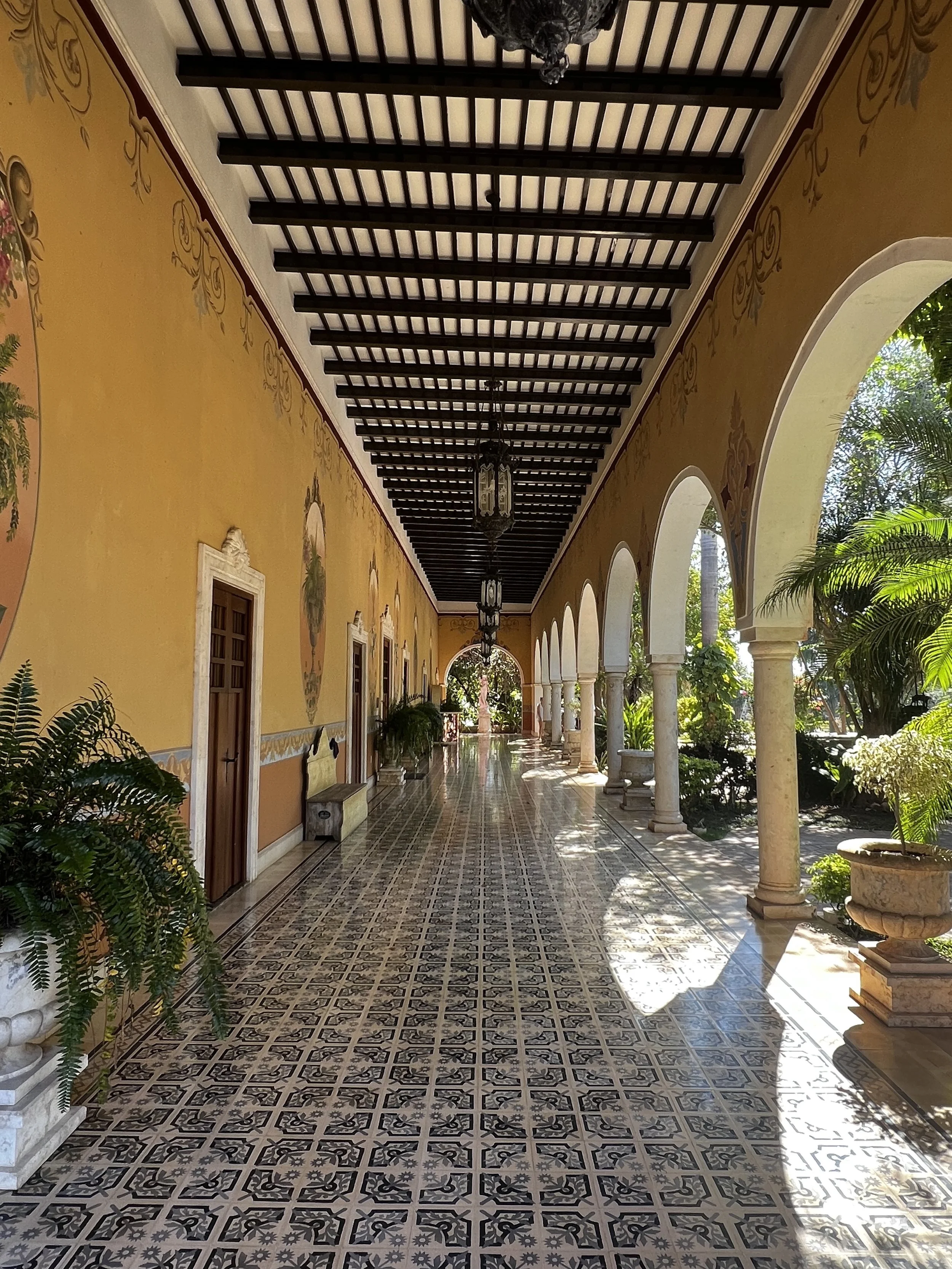
The contrast is immediate. Mérida is roughly a tenth the size of the capital, runs at a noticeably slower pace, and carries an architectural identity defined by colour, colonial structures, and the residue of nineteenth-century henequen-fibre wealth. The temperature is warmer. The streets are quieter. Dinners begin late and last long.
Mérida: four nights, with the right pacing
Four nights in Mérida is enough for the city itself, a day at one of the major archaeological sites, an afternoon at a cenote or two, and at least one slow day of nothing more strenuous than walking, eating, and disappearing through doorways into restored interiors most of which are quietly extraordinary.
Accommodation in Mérida favours boutique restorations of colonial-era buildings over international chains. The Cigno Hotel and Ya'ax Hotel Boutique both sit in the historic centre and work well as a base — small, restored, and visually quiet in the way the city's better hospitality tends to be. Several haciendas in the surrounding countryside also offer extraordinary stays for travellers who want a night or two outside the city.
Around Mérida: cenotes and the Maya world
The reason four nights works rather than three is what surrounds the city.
Cenotes — the freshwater sinkholes that perforate the limestone shelf across the Yucatán peninsula — are the region's most distinctive landscape feature. Some are open-air swimming spots with cliff edges and ropes; others descend into cavern systems lit through narrow apertures above. Cuzamá, Homún, and the area broadly known as the Ruta de los Cenotes around Mérida deliver several within an easy half-day drive. Picking two or three and treating an afternoon as cenote-only is one of the most pleasurable ways to spend a day in the region.
Chichén Itzá is the major archaeological day trip, and it justifies the visit despite its crowds. Uxmal, less famous and considerably quieter, is the choice for travellers who have already seen Chichén Itzá or who want the experience without the volume of visitors. The Puuc Route, threading several smaller Maya sites south of Mérida, offers a deeper version of the day still — better for second-time visitors or travellers genuinely interested in pre-Hispanic civilisation rather than passing through.
Why this pairing, and for whom
The strength of the Mexico City and Mérida pairing is contrast. The capital's intensity belongs to the first half of any trip; Mérida's slower register lands better in the second, when the appetite for stimulation has thinned and the appeal of long courtyard dinners and quiet mornings begins to register. Reverse the order and the trip ends on a stimulus high; in this order, it ends on a quiet that travels well home.
The pairing rewards travellers drawn to culture, architecture, food, and slower urban rhythms rather than beach holidays. First-time Mexico visitors willing to look beyond the resort coastline. Travellers who appreciate cities that reveal themselves through layered detail rather than headline landmarks.
It is less suited to those whose Mexico ideal involves direct beach access, or who want the social density of major resort destinations. The Riviera Maya and the Pacific coast are entirely worth their own trips. They are not what this pairing is about.
Neither city, separately, is particularly Mexico's reputation. Together, they encapsulate Mexico's substance.
Mexico is a destination where thoughtful planning can dramatically shape the experience. ALTEZA provides tailored itinerary design and advisory services for journeys throughout Mexico and beyond.